 Add to Chrome
 Add to Firefox
 Add to Edge
LamPO: A Lambda Style Policy Optimization for Reasoning Language Models
May 20, 2026
Reinforcement learning with verifiable rewards (RLVR) has become an effective paradigm for improving reasoning language models on tasks such as mathematics, coding, and scientific question answering. However, widely used group-relative objectives, such as GRPO, summarize each sampled group with scalar statistics and therefore discard fine-grained relational information among candidate responses. This weakens credit assignment under sparse outcome rewards, especially when multiple generated solutions differ only subtly in reasoning quality. We propose \textbf{LamPO}, a \textbf{Lambda-Style Policy Optimization} method that replaces scalar group advantages with a \emph{Pairwise Decomposed Advantage}. LamPO aggregates pairwise reward gaps within each response group and modulates each comparison by a confidence-aware weight computed from sequence log-probability differences, while retaining the critic-free and clipped-update structure of PPO-style optimization. When reference solutions are available, we further add a lightweight ROUGE-L-based dense auxiliary reward to reduce reward sparsity. Experiments on AIME24, AIME25, MATH-500, and GPQA-Diamond with Qwen3-1.7B, Qwen3-4B, and Phi-4-mini show that LamPO consistently improves over GRPO and recent RLVR variants, with more stable training dynamics and better sample efficiency.

LambdaPO: A Lambda Style Policy Optimization for Reasoning Language Models
May 19, 2026Group Relative Policy Optimization(GRPO) has become a cornerstone of modern reinforcement learning alignment, prized for its efficacy in foregoing an explicit value-critic by leveraging reward normalization across sampled trajectory cohorts. However, the method's reliance on a monolithic statistical baseline, such as the group mean, collapses the relational topology of the trajectory space into a single scalar, thereby erasing the fine-grained preference information essential for navigating complex, rank-sensitive reward landscapes. To address this issue, we introduce a novel framework, Lambda Policy Optimization (LambdaPO), that addresses this information-theoretic bottleneck by re-conceptualizing advantage estimation from a scalar value to a decomposed, pairwise preference structure. Specifically, the advantage for any given trajectory is formulated as the integrated sum of reward differentials against all peers in its cohort, where each pairwise comparison is dynamically attenuated by the policy's own probabilistic confidence in the established preference. To further mitigate the sparsity of binary outcome supervision, we augment the objective with a semantic density reward, derived from the precision-recall alignment between generated reasoning traces and ground-truth solutions. As a result, our method can mine more fine-grained optimization signals from a group of rollouts, guiding the LLM to a better optima. Experimental results across challenging math reasoning and question-answering tasks demonstrates that LambdaPO improves performance compared to the baseline methods.
Think, then Score: Decoupled Reasoning and Scoring for Video Reward Modeling
May 07, 2026Recent advances in generative video models are increasingly driven by post-training and test-time scaling, both of which critically depend on the quality of video reward models (RMs). An ideal reward model should predict accurate rewards that align with human preferences across diverse scenarios. However, existing paradigms face a fundamental dilemma: \textit{Discriminative RMs} regress rewards directly on features extracted by multimodal large language models (MLLMs) without explicit reasoning, making them prone to shortcut learning and heavily reliant on massive data scaling for generalization. In contrast, \textit{Generative RMs} with Chain-of-Thought (CoT) reasoning exhibit superior interpretability and generalization potential, as they leverage fine-grained semantic supervision to internalize the rationales behind human preferences. However, they suffer from inherent optimization bottlenecks due to the coupling of reasoning and scoring within a single autoregressive inference chain. To harness the generalization benefits of CoT reasoning while mitigating the training instability of coupled reasoning and scoring, we introduce DeScore, a training-efficient and generalizable video reward model. DeScore employs a decoupled ``think-then-score'' paradigm: an MLLM first generates an explicit CoT, followed by a dedicated discriminative scoring module consisting of a learnable query token and a regression head that predicts the final reward. DeScore is optimized via a two-stage framework: (1) a discriminative cold start incorporating a random mask mechanism to ensure robust scoring capabilities, and (2) a dual-objective reinforcement learning stage that independently refines CoT reasoning quality and calibrates the final reward, ensuring that higher-quality reasoning directly translates to superior model performance.
Beyond Where to Look: Trajectory-Guided Reinforcement Learning for Multimodal RLVR
Mar 27, 2026Recent advances in Reinforcement Learning with Verifiable Rewards (RLVR) for multimodal large language models (MLLMs) have mainly focused on improving final answer correctness and strengthening visual grounding. However, a critical bottleneck remains: although models can attend to relevant visual regions, they often fail to effectively incorporate visual evidence into subsequent reasoning, leading to reasoning chains that are weakly grounded in visual facts. To address this issue, we propose Trajectory-Guided Reinforcement Learning (TGRL), which guides the policy model to integrate visual evidence into fine-grained reasoning processes using expert reasoning trajectories from stronger models. We further introduce token-level reweighting and trajectory filtering to ensure stable and effective policy optimization. Extensive experiments on multiple multimodal reasoning benchmarks demonstrate that TGRL consistently improves reasoning performance and effectively bridges the gap between visual perception and logical reasoning.
Bridging Perception and Reasoning: Token Reweighting for RLVR in Multimodal LLMs
Mar 26, 2026Extending Reinforcement Learning with Verifiable Rewards (RLVR) to multimodal large language models (MLLMs) faces a fundamental challenge: their responses inherently interleave perception-related tokens, which ground visual content, with reasoning-related tokens, which construct reasoning chains. These token types instantiate distinct yet interdependent capacities -- visual grounding and symbolic reasoning -- making isolated optimization insufficient. Through token-level empirical analysis, we demonstrate that optimizing either perception- or reasoning-only tokens consistently underperforms full optimization, underscoring their inherent coupling. To address this, we propose a plug-and-play Token-Reweighting (ToR) strategy that explicitly models this interdependence by identifying critical tokens of both types and dynamically reweighting them during RLVR training. Applied on top of existing methods (e.g., GRPO and DAPO), ToR delivers consistent performance gains across multiple multi-modal reasoning benchmarks, achieving state-of-the-art performance with both accurate visual grounding and coherent reasoning.
Enhancing Multi-Modal LLMs Reasoning via Difficulty-Aware Group Normalization
Feb 26, 2026Reinforcement Learning with Verifiable Rewards (RLVR) and Group Relative Policy Optimization (GRPO) have significantly advanced the reasoning capabilities of large language models. Extending these methods to multimodal settings, however, faces a critical challenge: the instability of std-based normalization, which is easily distorted by extreme samples with nearly positive or negative rewards. Unlike pure-text LLMs, multimodal models are particularly sensitive to such distortions, as both perceptual and reasoning errors influence their responses. To address this, we characterize each sample by its difficulty, defined through perceptual complexity (measured via visual entropy) and reasoning uncertainty (captured by model confidence). Building on this characterization, we propose difficulty-aware group normalization (Durian), which re-groups samples by difficulty levels and shares the std within each group. Our approach preserves GRPO's intra-group distinctions while eliminating sensitivity to extreme cases, yielding significant performance gains across multiple multimodal reasoning benchmarks.
Learning from Next-Frame Prediction: Autoregressive Video Modeling Encodes Effective Representations
Dec 24, 2025


Recent advances in pretraining general foundation models have significantly improved performance across diverse downstream tasks. While autoregressive (AR) generative models like GPT have revolutionized NLP, most visual generative pretraining methods still rely on BERT-style masked modeling, which often disregards the temporal information essential for video analysis. The few existing autoregressive visual pretraining methods suffer from issues such as inaccurate semantic localization and poor generation quality, leading to poor semantics. In this work, we propose NExT-Vid, a novel autoregressive visual generative pretraining framework that utilizes masked next-frame prediction to jointly model images and videos. NExT-Vid introduces a context-isolated autoregressive predictor to decouple semantic representation from target decoding, and a conditioned flow-matching decoder to enhance generation quality and diversity. Through context-isolated flow-matching pretraining, our approach achieves strong representations. Extensive experiments on large-scale pretrained models demonstrate that our proposed method consistently outperforms previous generative pretraining methods for visual representation learning via attentive probing in downstream classification.
AdaViP: Aligning Multi-modal LLMs via Adaptive Vision-enhanced Preference Optimization
Apr 22, 2025Preference alignment through Direct Preference Optimization (DPO) has demonstrated significant effectiveness in aligning multimodal large language models (MLLMs) with human preferences. However, existing methods focus primarily on language preferences while neglecting the critical visual context. In this paper, we propose an Adaptive Vision-enhanced Preference optimization (AdaViP) that addresses these limitations through two key innovations: (1) vision-based preference pair construction, which integrates multiple visual foundation models to strategically remove key visual elements from the image, enhancing MLLMs' sensitivity to visual details; and (2) adaptive preference optimization that dynamically balances vision- and language-based preferences for more accurate alignment. Extensive evaluations across different benchmarks demonstrate our effectiveness. Notably, our AdaViP-7B achieves 93.7% and 96.4% reductions in response-level and mentioned-level hallucination respectively on the Object HalBench, significantly outperforming current state-of-the-art methods.
DAMO: Data- and Model-aware Alignment of Multi-modal LLMs
Feb 04, 2025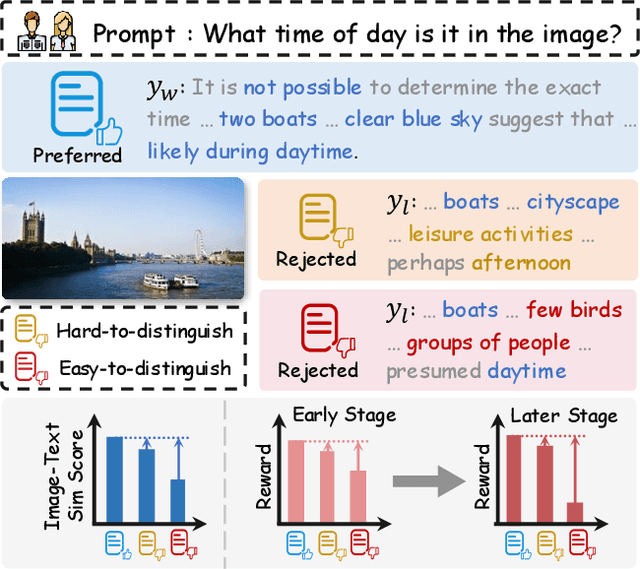
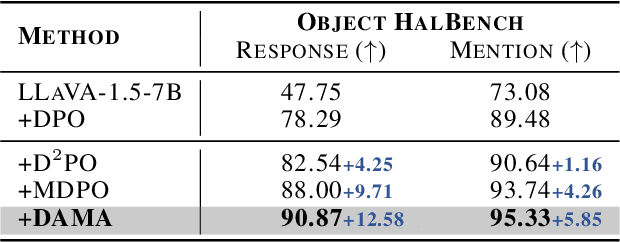

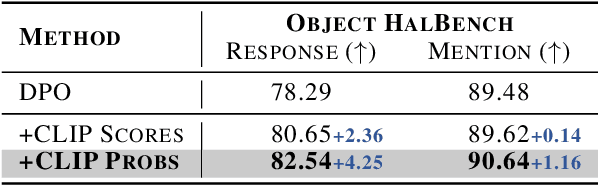
Direct Preference Optimization (DPO) has shown effectiveness in aligning multi-modal large language models (MLLM) with human preferences. However, existing methods exhibit an imbalanced responsiveness to the data of varying hardness, tending to overfit on the easy-to-distinguish data while underfitting on the hard-to-distinguish data. In this paper, we propose Data- and Model-aware DPO (DAMO) to dynamically adjust the optimization process from two key aspects: (1) a data-aware strategy that incorporates data hardness, and (2) a model-aware strategy that integrates real-time model responses. By combining the two strategies, DAMO enables the model to effectively adapt to data with varying levels of hardness. Extensive experiments on five benchmarks demonstrate that DAMO not only significantly enhances the trustworthiness, but also improves the effectiveness over general tasks. For instance, on the Object HalBench, our DAMO-7B reduces response-level and mentioned-level hallucination by 90.0% and 95.3%, respectively, surpassing the performance of GPT-4V.
DiffGAD: A Diffusion-based Unsupervised Graph Anomaly Detector
Oct 09, 2024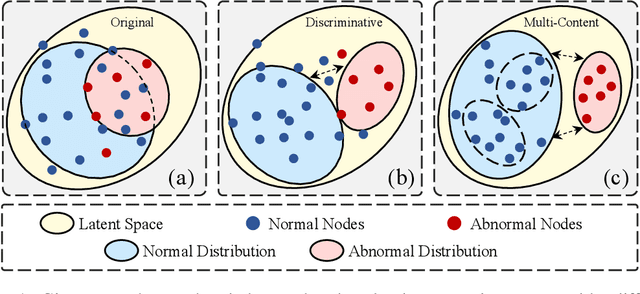
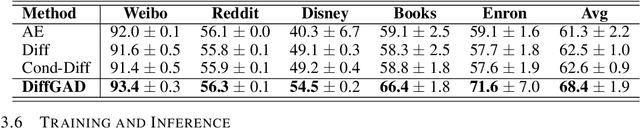
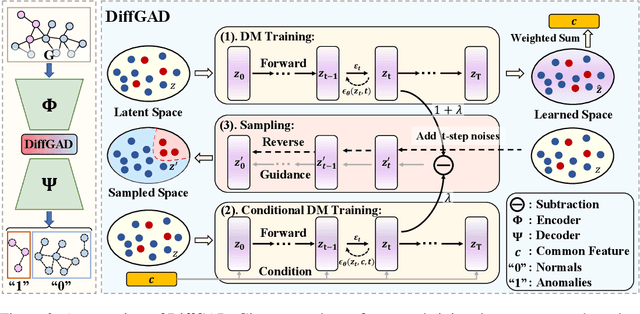
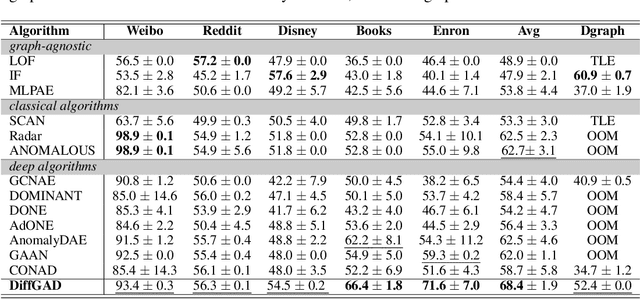
Graph Anomaly Detection (GAD) is crucial for identifying abnormal entities within networks, garnering significant attention across various fields. Traditional unsupervised methods, which decode encoded latent representations of unlabeled data with a reconstruction focus, often fail to capture critical discriminative content, leading to suboptimal anomaly detection. To address these challenges, we present a Diffusion-based Graph Anomaly Detector (DiffGAD). At the heart of DiffGAD is a novel latent space learning paradigm, meticulously designed to enhance its proficiency by guiding it with discriminative content. This innovative approach leverages diffusion sampling to infuse the latent space with discriminative content and introduces a content-preservation mechanism that retains valuable information across different scales, significantly improving its adeptness at identifying anomalies with limited time and space complexity. Our comprehensive evaluation of DiffGAD, conducted on six real-world and large-scale datasets with various metrics, demonstrated its exceptional performance.